Cisco has confirmed that attackers are actively exploiting a critical vulnerability in the software many businesses use to connect their offices together. The flaw, tracked as CVE-2026-76504 and rated 9.8 out of 10 on the CVSS severity scale, affects Cisco Catalyst SD-WAN Manager. It lets a remote attacker slip past a login check and gain administrator-level access to a protected management API. The U.S. Cybersecurity and Infrastructure Security Agency (CISA) has already added it to its Known Exploited Vulnerabilities (KEV) catalog and gave federal agencies until October 3, 2026 to fix it.
If your organization uses Cisco SD-WAN to link branch offices, remote sites, or cloud resources, this is not a "next maintenance window" issue. It is a "this week" issue. This guide explains what the flaw is, why it matters even if you have never heard the term SD-WAN, who is at risk, and the specific steps to take now.
What Is SD-WAN, and Why Does This Flaw Matter?SD-WAN stands for software-defined wide area network. In plain English, it is the technology that ties a company's locations together and decides how traffic travels between offices, data centers, the internet, and cloud services like Microsoft 365. Instead of configuring each router by hand, IT teams manage the whole network from one central console.
For Cisco customers, that console is Cisco Catalyst SD-WAN Manager, a product that started life at a company called Viptela, became part of Cisco in 2017, and was known as "vManage" until Cisco renamed it in 2023. Because SD-WAN Manager controls the entire network, it is one of the most sensitive systems a business owns. Whoever controls it can potentially reroute, monitor, or disrupt traffic for every connected location.
That is what makes CVE-2026-76504 so serious. It does not target a single laptop or a single server. It targets the control center.
How the Attack Works
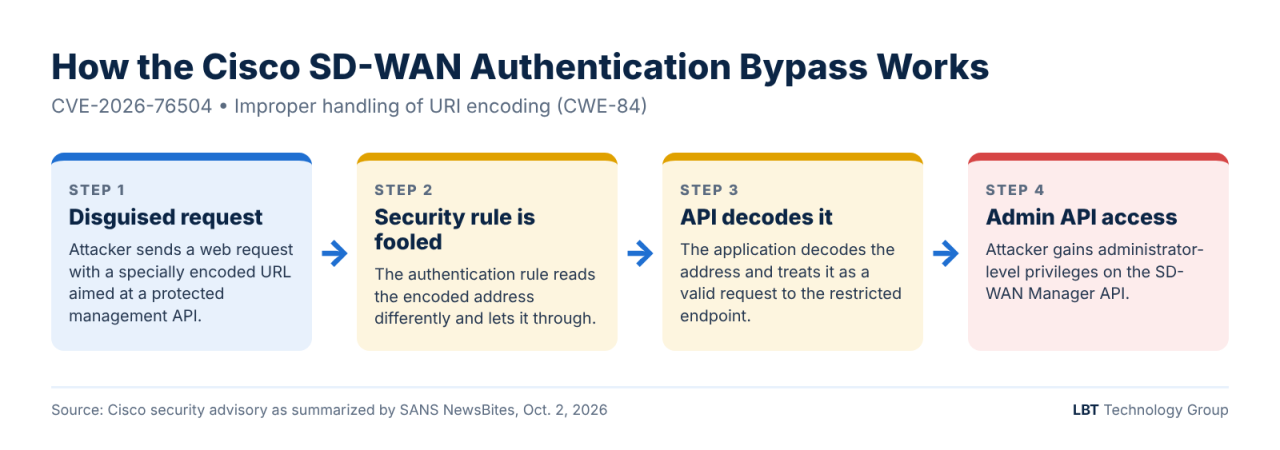
According to Cisco, the vulnerability is caused by
improper handling of URI encoding in an HTTP request. That sounds technical, but the idea is simple. Web addresses can be written in more than one way. Certain characters can be "encoded" so that the same address looks different on the surface while meaning the same thing underneath. In this case, the security rule that is supposed to block unauthenticated users from a specific API endpoint reads an encoded request one way. The application behind that rule decodes it and reads it another way. The attacker's disguised request slips past the gatekeeper and arrives at the protected endpoint as though it were legitimate. The result is administrator-level privileges on the SD-WAN Manager API.
The security rule and the application disagree about what the request says, and the attacker exploits the gap.
Security experts have pointed out that this is an old class of bug. This weakness type, formally known as CWE-84, dates back to the early 2000s era of internet worms. As SANS NewsBites editor Ed Skoudis put it, the fix is a basic principle: normalize the request first, then make the security decision on the cleaned-up version. When security controls and the software behind them do not agree on what a request says, attackers live in the gap.
How it was discovered
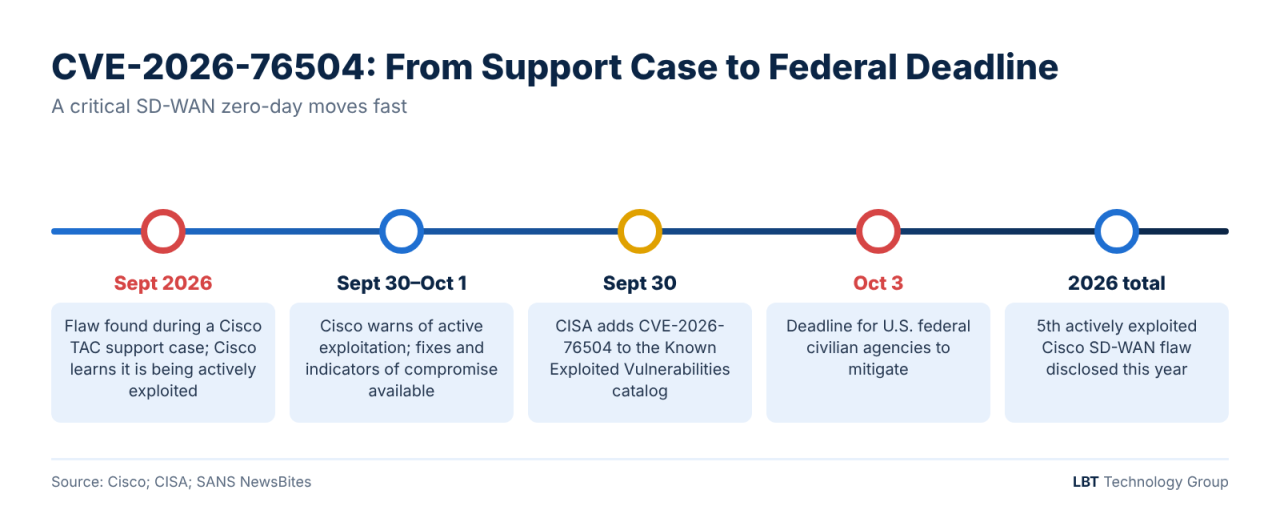
Cisco found the flaw while resolving a customer support case through its Technical Assistance Center (TAC). The Cisco Product Security Incident Response Team (PSIRT) then learned in September 2026 that it was already being exploited in real attacks. In other words, attackers found and used this weakness before most customers knew it existed. That is the definition of a zero-day.
Why This One Deserves Your Attention
Plenty of vulnerabilities make headlines every week. A few details make this one stand out:
- It is already being exploited. This is not a theoretical risk or a lab demonstration. Cisco has confirmed active attacks and published indicators of compromise (IoCs) to help customers check their systems.
- It is the fifth this year. CVE-2026-76504 is the fifth actively exploited Cisco SD-WAN vulnerability disclosed in 2026. Attackers are clearly paying close attention to this product line.
- It is critical severity. A CVSS score of 9.8 means it is remotely exploitable, requires no login, and has a severe impact.
- The federal government set a three-day deadline. CISA added the flaw to its KEV catalog with an October 3 deadline for federal civilian agencies. Short deadlines like this are a strong signal of real-world risk for private businesses as well.
From discovery to federal deadline in a matter of days.
Who Is at Risk?
Any organization running an unpatched version of Cisco Catalyst SD-WAN Software is exposed. The risk is highest when the SD-WAN Manager interface can be reached from the internet, which is more common than many business owners realize. Cisco has released fixes for the following software trains. If you are running anything older than 20.9, there is no direct patch, and you will need to migrate to a supported, fixed release.
|
Your current version |
Fixed release available? |
What to do |
|
26.2 |
Yes |
Update to the fixed 26.2 release |
|
26.1 | Yes | Update to the fixed 26.1 release |
20.18
| Yes | Update to the fixed 20.18 release |
| 20.15 | Yes |
Update to the fixed 20.15 release |
| 20.12 | Yes | Update to the fixed 20.12 release |
| 20.9 | Yes | Update to the fixed 20.9 release |
| Older than 20.9 | No | Migrate to a supported fixed release |
What an attacker could do
With administrator access to the SD-WAN Manager API, an attacker could:
- Change routing and network settings to redirect, intercept, or disrupt traffic between offices
- Create unauthorized VPN tunnels that blend in with legitimate ones
- Map your network to plan deeper attacks on servers and data
- Plant persistent access that survives even after the software is patched
- Cause outages that disrupt operations across multiple sites at once
One SANS NewsBites editor made a practical point here: most organizations do not actually know which VPN tunnels in their environment are legitimate. If you do not have an up-to-date list of approved tunnels, an attacker's tunnel can hide in plain sight. Tools like NetBox or a data center infrastructure management (DCIM) system can help keep that inventory current.
How to Respond Now
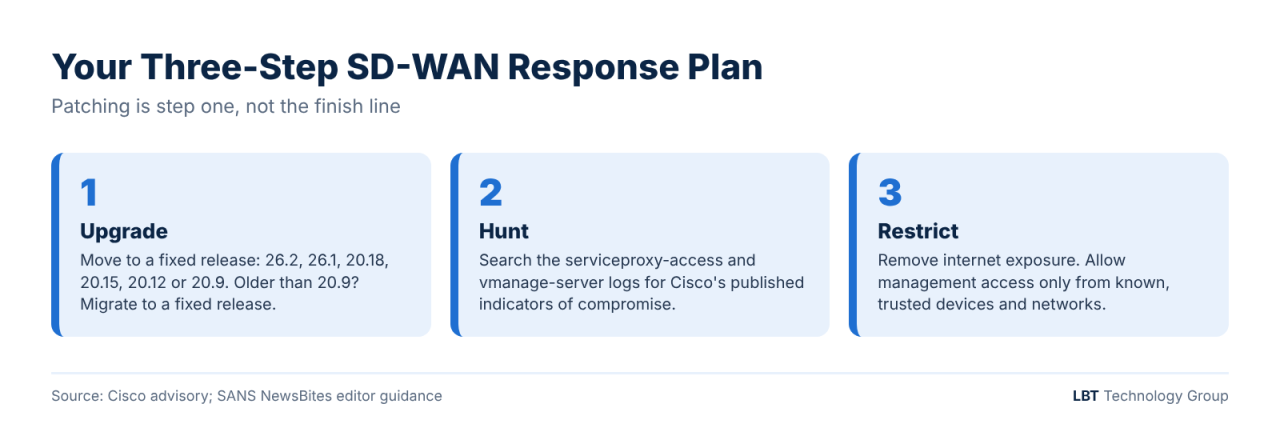
SANS editor Lee Neely summarized the response in three steps: upgrade, hunt, and restrict. Here is how that looks in practice.
Patching closes the door; hunting finds anyone who already walked through it.
1. Upgrade immediately. Apply Cisco's fixed release for your version. If you are on a version older than 20.9, plan an urgent migration to a supported release.
2. Hunt for signs of compromise. Review the service proxy-access log and vmanage-server log files for the indicators of compromise listed in Cisco's advisory. Patching stops new attacks, but it does not remove an attacker who already got in.
3. Take management off the internet. Restrict access to SD-WAN Manager so only known, trusted devices and administrative networks can reach it.
4. Audit your tunnels. Compare active VPN tunnels and connections against a documented list of approved ones and investigate anything unfamiliar.
5. Centralize your logs. Forward network device logs to a SIEM or central logging platform and keep them long enough to investigate an attack that started weeks before you noticed it.
6. Rotate credentials if anything looks off. Reset administrator passwords, API keys, and service accounts associated with the SD-WAN environment.
If any of this feels like more than your internal team can take on during a busy week, that is exactly the gap a managed IT and security partner is built to close. LBT Technology Group, LLC. can help confirm your SD-WAN version, apply fixes safely, check for indicators of compromise, and lock down management access. Contact our team for a no-pressure review of your network edge.
The Bottom Line
CVE-2026-76504 is a critical, actively exploited flaw in the system that controls how your offices talk to each other. The fix is available, the federal deadline is days away, and attackers are already using it. Update now, check for signs that someone got in before you patched, and make sure your network's control center is not reachable from the open internet. Five exploited SD-WAN flaws in one year is a pattern, not a coincidence, and it is a good reason to treat network equipment with the same patching discipline you apply to laptops and servers.
Frequently Asked Questions
I use Cisco equipment. Am I automatically affected?
No. This flaw affects Cisco Catalyst SD-WAN Software, specifically SD-WAN Manager (formerly vManage). If you use other Cisco products but not SD-WAN, this specific vulnerability does not apply, although you should still keep all Cisco devices updated.
Do I need a login for the attacker to succeed?
No. The flaw is an authentication bypass, which means the attacker does not need valid credentials to reach the protected API. That is a big part of why it is rated 9.8 out of 10.
If I patch today, am I safe?
Patching stops new exploitation of this flaw. However, if your system was attacked before you patched, the attacker may have created accounts, tunnels, or other access that the patch does not remove. That is why checking for indicators of compromise is just as important as updating.
What does it mean that CISA added this to the KEV catalog?
The Known Exploited Vulnerabilities catalog lists flaws that CISA has confirmed are being used in real attacks. Federal agencies are required to fix them by a set deadline. For private businesses, a KEV listing is one of the clearest signals that a vulnerability should go to the top of the patch list.
My SD-WAN is managed by a provider. What should I do?
Ask your provider directly whether your environment runs an affected version, when it was or will be patched, and whether they have checked the logs for Cisco's indicators of compromise. Get the answers in writing.
Sources & Further Reading