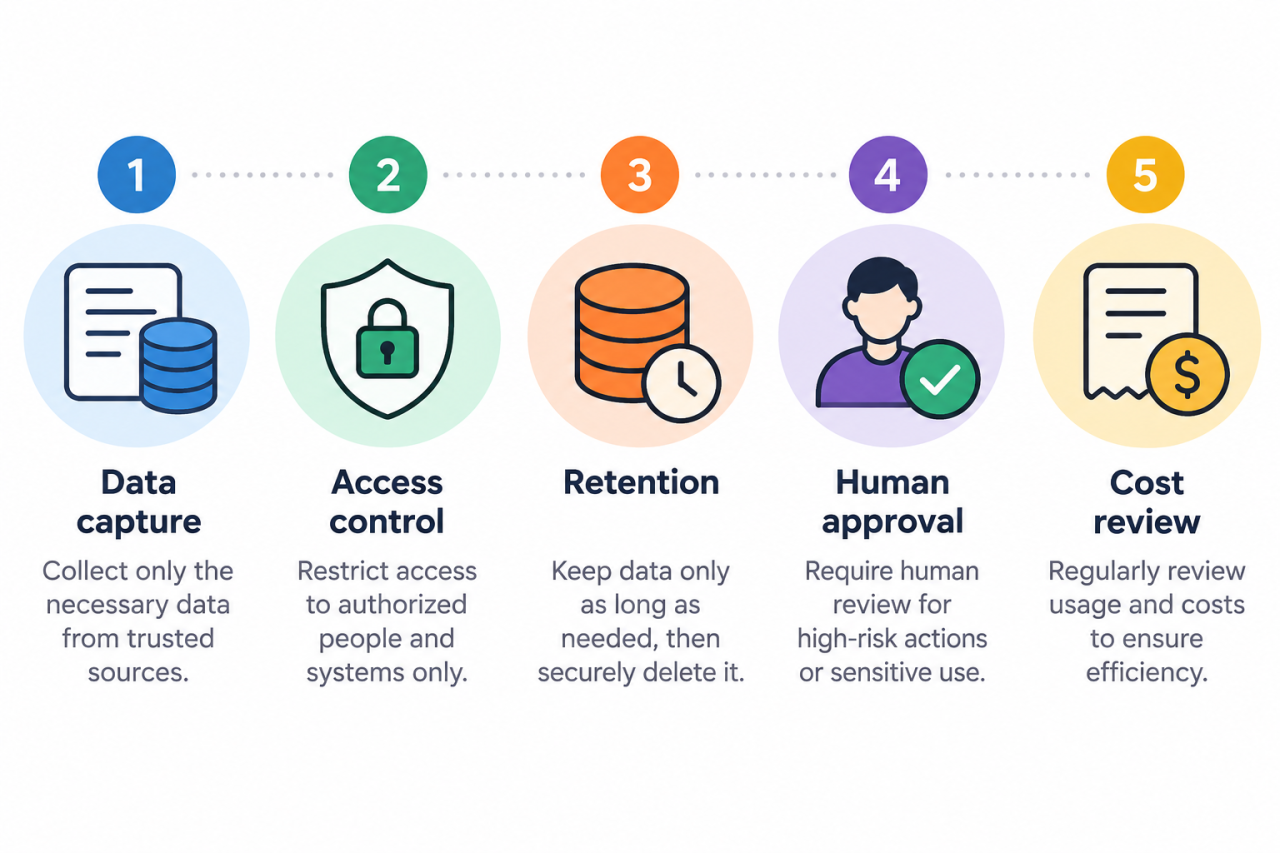
What information will it capture?
Identify which meetings, calls, chats, and documents are in scope. Decide whether sensitive conversations should be excluded.

Think about your last team meeting. Someone agreed to call a customer. Another person promised to revise a proposal. A manager mentioned a deadline that never made it onto the calendar. By Friday, everyone remembers the conversation a little differently.
Now imagine being able to ask your business software, "What did we promise the customer, and who is following up?" and receive an answer drawn from the meeting, the related messages, and the customer record.
That is the direction workplace technology is moving. And it raises a question worth asking before the next AI feature is switched on: If software can remember so much about your business, who decides what it is allowed to remember, share, and act upon?
On October 20, 2026, Zoom announced its new Unified Context Layer, an approach that brings together information from meetings, phone calls, chats, documents, and connected business applications. The goal is to help people and AI tools understand what happened across different conversations and turn that information into useful next steps.
Zoom also described features that can search across connected applications, coordinate AI-assisted work, and move meeting follow-ups into other systems. Some capabilities are available now; others are planned for later in 2026 or 2027. Availability depends on the feature, product, and plan.
This is bigger than a new meeting summary button. It reflects a broader shift: business conversations are becoming information that software can search, connect, and potentially use to initiate work.
Why Small Businesses Should Care
In a small company, valuable information often lives in people's heads, email threads, meeting notes, and separate software platforms. That makes it easy to miss a handoff or repeat work that someone already completed.
Imagine a professional services firm finishing a client call. With appropriate settings and approvals, AI could help draft the meeting summary, identify promised deliverables, and prepare follow-up tasks. A service team might locate an earlier customer decision without asking three colleagues to search their inboxes. A sales manager could prepare for a conversation by reviewing relevant account history.
The potential benefits are straightforward less time chasing information, fewer forgotten commitments, faster customer responses, and more consistent handoffs between employees. Those are meaningful improvements for a business that cannot simply hire another person whenever its workload grows.
But the benefits are not automatic. AI summaries can omit important context, misidentify a speaker, or misunderstand a decision. The quality of the result still depends on the underlying information and on someone verifying what matters.
A meeting might contain a customer's financial details, an employee issue, a proposed acquisition, a patient-related discussion, or a confidential legal strategy. The people in that conversation may have expected a limited audience not a permanent, searchable record available through several connected tools.
When AI systems link conversations with documents and business applications, a few risks deserve special attention.
Privacy and confidentiality
Recording, transcription, retention, and sharing settings matter. Employees and customers should understand when AI-assisted capture is taking place. A searchable summary can expose sensitive information just as readily as the original recording.
Access and cybersecurity
An AI tool that can search multiple systems may surface information to someone who should not receive it if permissions are poorly configured. Third-party connectors also introduce another place to review authorization, vendor access, and activity logs. Access should be limited to the information and actions required for a legitimate business purpose.
Operational and financial surprises
An inaccurate summary can become an incorrect customer promise. An automated workflow can send a message or update a record before a person checks it. Subscription tiers, usage-based charges, integrations, training, and support can also make the real cost greater than the advertised price.
Compliance and recordkeeping
Healthcare, financial services, legal, and other regulated organizations may have obligations governing confidentiality, consent, records retention, vendor agreements, and access to sensitive data. An AI-generated meeting note is not automatically exempt from those obligations. Enabling a feature does not, by itself, establish regulatory compliance.
Vendors Are Adding Controls But Timing Matters
Zoom's October announcement also included security and governance capabilities. Its Microsoft Purview sensitivity-label integration for supported Zoom Meetings and Whiteboard scenarios is available now, according to Zoom. Centralized AI management and deepfake risk detection are expected in December 2026. Additional custom AI guardrails and AI-content archiving capabilities are planned for 2027.
These are encouraging developments, but planned safeguards should not be treated as protections already deployed. Businesses should verify what is available in their own environment, what requires an additional license, and whether the controls meet their actual requirements.
The promise of AI-powered meeting intelligence is not that every conversation becomes another report. It is that fewer important details fall through the cracks and employees can spend more time serving customers instead of reconstructing yesterday's decisions.
At LBT Technology Group, LLC., we believe adopting technology should begin with a clear business objective and an honest assessment of risk. Our approach goes beyond protecting individual systems to helping organizations understand how technology, access, people, and processes affect their overall cybersecurity risk.
Before your organization gives AI a larger role in its daily operations, make sure the information it uses is properly governed and that someone remains accountable for the results.
To discuss secure technology adoption, IT optimization, and cybersecurity risk management for your business, visit https://lbttechgroup.com.
Identify which meetings, calls, chats, and documents are in scope. Decide whether sensitive conversations should be excluded.
Review user permissions, sharing defaults, external access, and connections to other applications. Test with ordinary employee accounts not just an administrator.
Set appropriate retention and deletion rules for recordings, transcripts, summaries, and generated tasks. Account for legal and contractual requirements.
Start with drafting and summarizing. Require approval before sending customer communications, modifying important records, or taking actions with financial consequences.
Pilot one low-risk workflow. Track time saved, accuracy, employee adoption, licensing costs, and any unexpected data exposure before expanding.
Necessary cookies support essential features such as secure sessions and forms. Analytics is optional and stays off unless you allow it.
Required for core site functions, security, and preferences.