

NIST’s New Small Business Guide Lands the Same Week a Live VPN Threat Proves Why It Matters
This week, NIST published its first cybersecurity guide written specifically for businesses too small to have an IT department and days later, CISA confirmed active exploitation of a VPN flaw sitting on firewalls many of those same businesses rely on, proving the guidance couldn't have arrived at a better time.
If you run a small or mid-sized business, this past week delivered a useful coincidence: the federal government published fresh, plain-language guidance on protecting your business, and the threat landscape immediately supplied a textbook example of why that guidance exists.
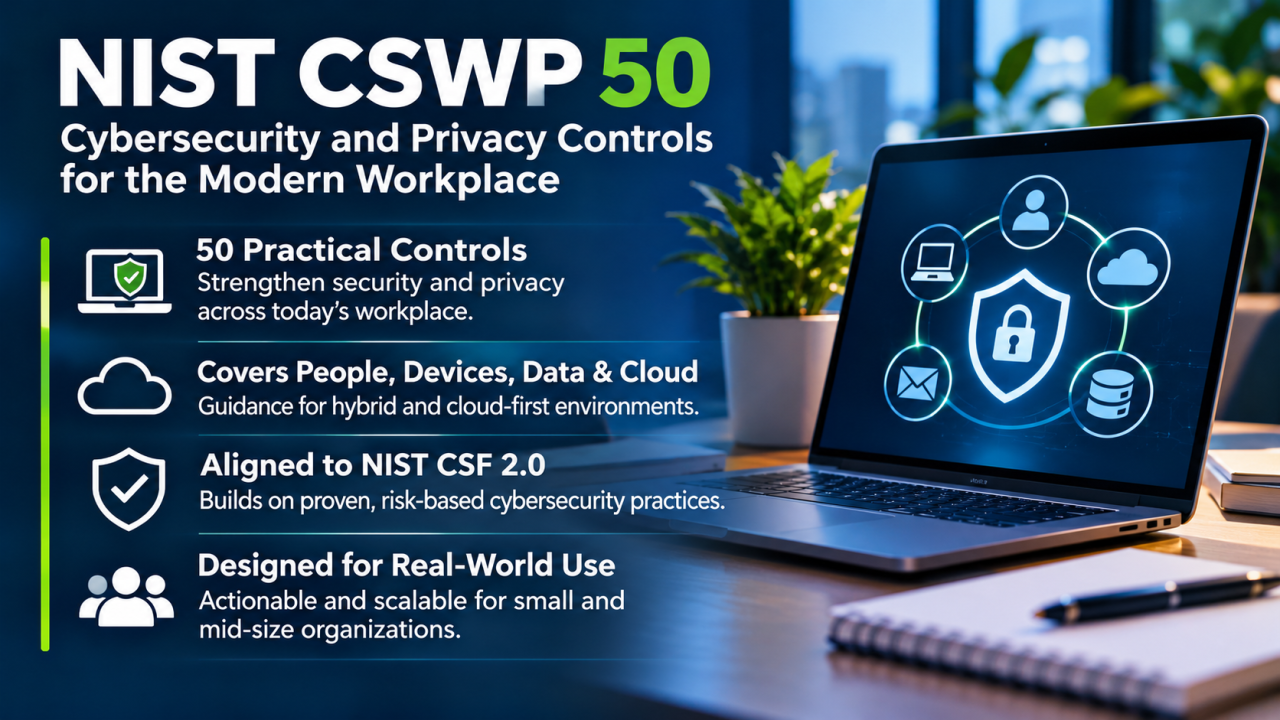
On November 4, the National Institute of Standards and Technology (NIST) released Small Business Cybersecurity: Non-Employer Firms, a new publication (NIST CSWP 50) built for solopreneurs, freelancers, independent contractors, and single-owner businesses the roughly 82% of America's 34.8 million small businesses that have no paid staff beyond the owner. Five days later, on November 9, security researchers and SANS Internet Storm Center's daily Stormcast flagged a different kind of warning: an actively exploited authentication flaw in SonicWall's SonicOS SSL-VPN software, the kind of device that sits at the edge of thousands of small-business networks. Together, the two stories make the same point from opposite directions good cybersecurity habits aren't optional anymore, and even "boring" infrastructure like a VPN appliance needs a maintenance plan.
A Playbook for Businesses That Never Expected to Need One
NIST's new guide fills a real gap. Most existing frameworks, including NIST's own Cybersecurity Framework (CSF) 2.0, are written with an IT department in mind someone to assign tasks to, a budget line to draw from, a team to run tabletop exercises. CSWP 50 assumes none of that. It's written for the reader who has "no familiarity with cybersecurity or the NIST CSF," as co-author Daniel Eliot put it in NIST's release announcement, because "solopreneurs may not have cybersecurity expertise."
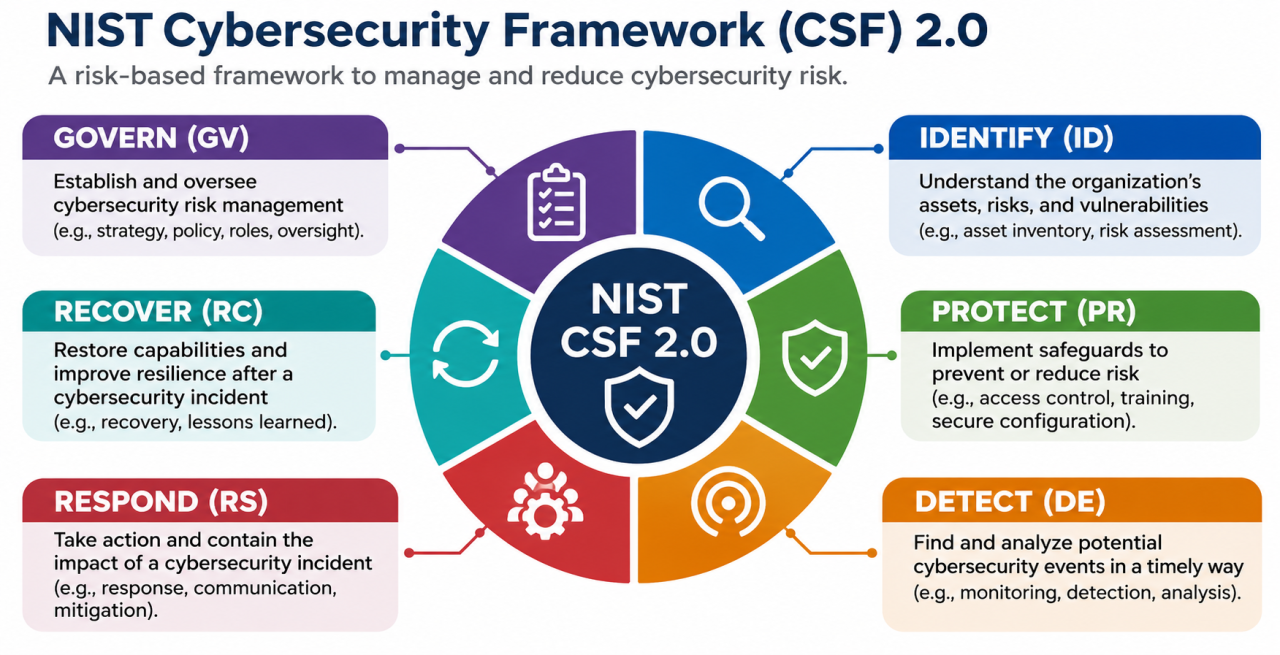
The guidance maps to the CSF 2.0's six functions Govern, Identify, Protect, Detect, Respond, and Recover, but translates each one into tasks a single owner can actually do in an afternoon: inventory your devices, accounts, and software; turn on multi-factor authentication everywhere it's offered, favoring phishing-resistant methods for email, banking, and cloud storage; move toward passkeys and long, unique passphrases; keep software patched; use a standard (non-admin) account for everyday work; back up data and actually test that the backup restores; and keep a paper list of who to call an attorney, an incident response contact, your insurer before you ever need it.
Two pieces of the guidance are worth calling out for any business that works with an outside IT provider or is weighing whether to hire one. First, it tells readers that if they bring on a cybersecurity provider, they should get the scope of work and responsibilities in writing and that the business, not the vendor, remains ultimately accountable for its own security. Second, it adds a timely note on artificial intelligence: before entering sensitive data into an AI tool, check how that provider stores, shares, and trains on your information, and always review AI-generated content before relying on it. For a solo operator juggling bookkeeping software, a CRM, and now a growing list of AI assistants, that's a genuinely new category of vendor risk nobody was writing guidance for a few years ago.
The Vulnerability That Makes the Case for You
Guidance is easy to file away and forget, which is where this week's second story comes in. On November 9, Help Net Security, citing SonicWall's own advisory and a report from IT services provider Electronic Office, detailed CVE-2026-19868: an authentication enforcement flaw in SonicOS's SSL-VPN service that lets someone with valid credentials for an alternate login method bypass SAML-based single sign-on and any multi-factor authentication enforced through it. It isn't an open-the-door-to-anyone bug; an attacker still needs working credentials first. But once they have them, from a leaked password, a phishing kit, or a prior breach, MFA stops being the safety net it's supposed to be.
SonicWall says it has "investigated a report indicating potential exploitation," and CISA added the flaw to its Known Exploited Vulnerabilities catalog on evidence of active attacks, giving federal civilian agencies until November 20 to patch. SANS Internet Storm Center covered the flaw in its Monday, November 9 Stormcast alongside two other actively exploited bugs disclosed the same week, underscoring how routine this kind of rapid-exploitation cycle has become. The affected products are Gen7 and Gen8 SonicWall firewalls running firmware 7.3.3-7015 or 8.2.2-8015 and earlier; fixes are available in 7.3.4-7013 and 8.2.3-8015. Gen6 devices have already reached end of support, and SonicWall is pushing customers toward Gen8 hardware.
SonicWall firewalls are a fixture in small-business and MSP-managed networks precisely because they're affordable and easy to deploy, which is exactly why a flaw like this matters so much to this audience. It's a near-perfect illustration of NIST's "Protect" and "Detect" functions in action: patching promptly closes the hole, but reviewing VPN logs for sign-ins that completed without a matching identity-provider check is what catches anyone who got in before the patch was applied.
The Pattern Behind the Headlines
This vulnerability didn't appear in isolation. The same week, researchers at Sophos reported that the Aur0ra ransomware group is using AI agents to handle reconnaissance and credential collection inside victim networks letting a smaller crew move at a scale and speed that used to require a much larger team. CrowdStrike separately disclosed a China-linked group using AI agents to hit more than 200 organizations in just eleven days. The common thread across this week's cybersecurity news, from CSWP 50 to the SonicWall flaw to AI-accelerated ransomware operations, is that attackers are automating the easy, repetitive parts of a breach, while the defensive basics that stop most of them MFA, patching, backups, and a documented plan remain stubbornly manual, and stubbornly effective when they're actually in place.
What This Means for Your Business
None of this requires a security team to act on. It requires a short list of habits, consistently applied, and — for many small and mid-sized businesses a partner who keeps that list current when the news cycle doesn't slow down.
If your business touches regulated data, the stakes are higher still. Healthcare organizations and their vendors are still expected to meet HIPAA Security Rule safeguards regardless of company size; any business in the Department of Defense supply chain is working toward CMMC Level 2 certification; and schools and their edtech vendors have FERPA obligations around student data that extend to third parties. In every one of those cases, the NIST CSF 2.0 functions behind CSWP 50, paired with the more technical controls in the CIS Controls, are the common backbone auditors and regulators expect to see whether you're a solo contractor or a 200-person regulated firm.
A few concrete next steps worth taking this week:
- Confirm your firewall and VPN firmware is current, and if you run SonicWall Gen7 or Gen8 hardware, verify you're on 7.3.4-7013/8.2.3-8015 or later now, not at your next scheduled maintenance window.
- Make sure MFA is enabled everywhere it's offered and if you use SAML-based single sign-on, double-check that MFA is being enforced through it, not bypassable through a secondary login method.
- Put your incident response contacts IT provider, legal counsel, cyber insurer on paper, not just in a phone you might lose in an incident.
- If you're evaluating or renewing an IT or cybersecurity provider, ask how their services map to the NIST CSF functions and CIS Controls, and get the division of responsibility in writing.
The Bottom Line
This week's news wasn't really about one guide or one vulnerability. It was a reminder that the gap between "small business" and "target" has closed. Attackers don't check company size before they scan for an unpatched VPN appliance, and regulators don't offer smaller businesses a pass on HIPAA, CMMC, or FERPA obligations just because there's no dedicated IT department to enforce them. The good news is that the fundamentals NIST just restated in plain language know what you have, lock down access, patch what's exposed, back up what matters, and have a plan are exactly the fundamentals a good IT and compliance partner handles as a matter of routine. If this week's headlines raised any questions about where your business stands, that's a conversation worth having before the next advisory lands, not after.
Related Resources

NIST publishes cybersecurity guide for businesses too small to have IT staff - Help Net Security
Ransomware gang talked AI agents into doing much of its dirty work - Help Net Security

Exploited SonicWall SSL-VPN flaw lets attackers bypass SAML-enforced MFA (CVE-2026-19868) - Help Net Security

SANS Stormcast Tuesday, August 18th, 2026: Apple Patches; Screen Sharing Security; Download More RAM

CISA Adds One Known Exploited Vulnerability to Catalog | CISA